
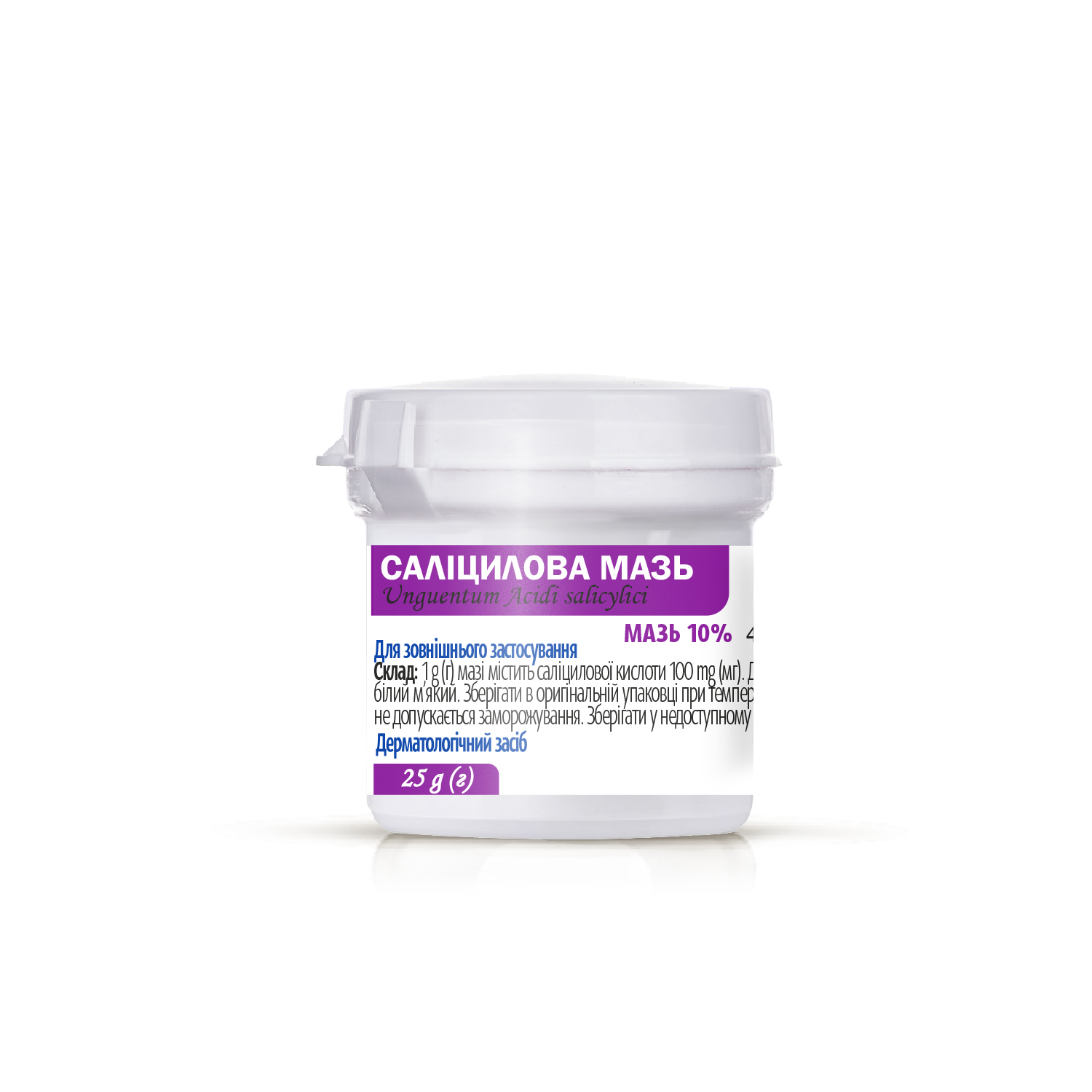
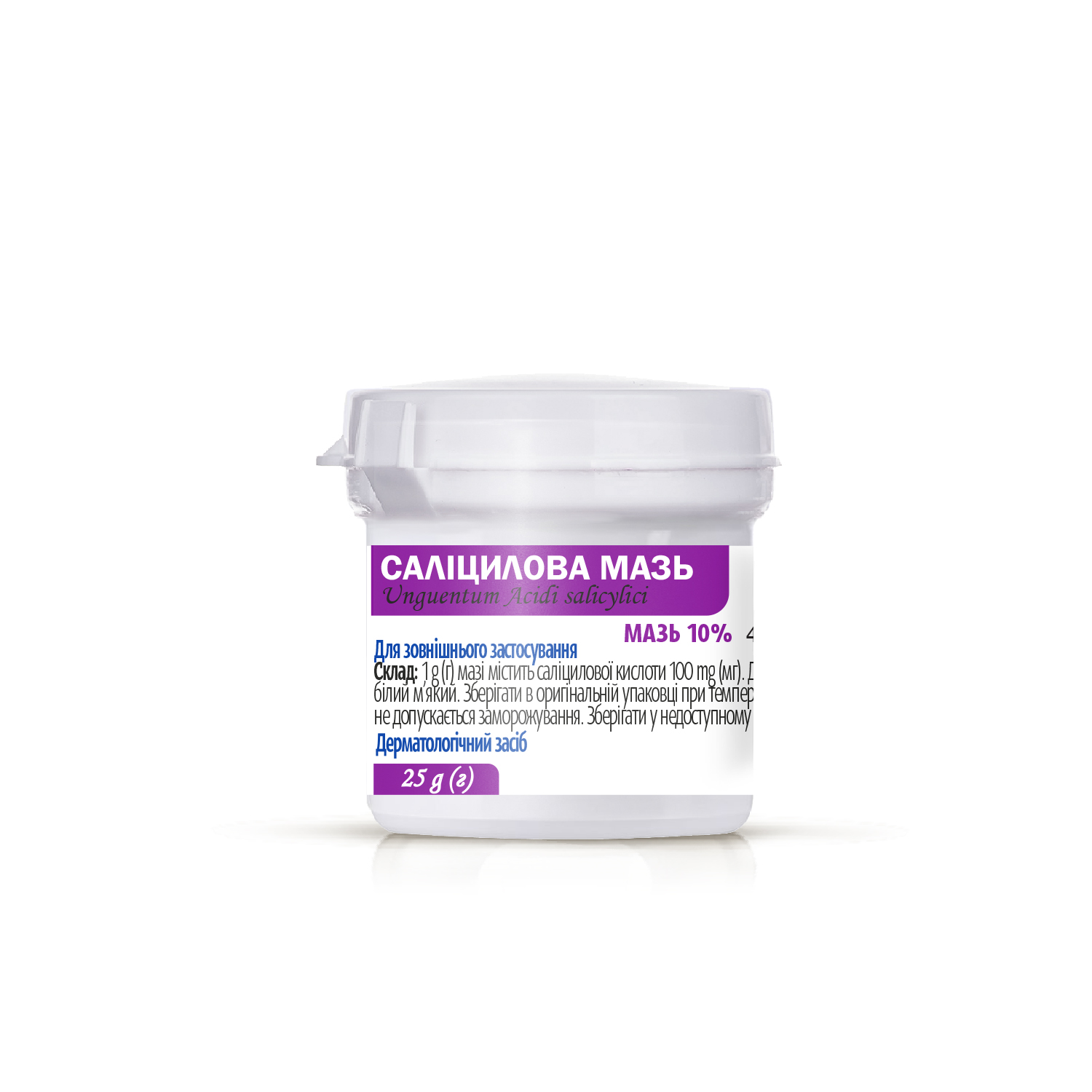
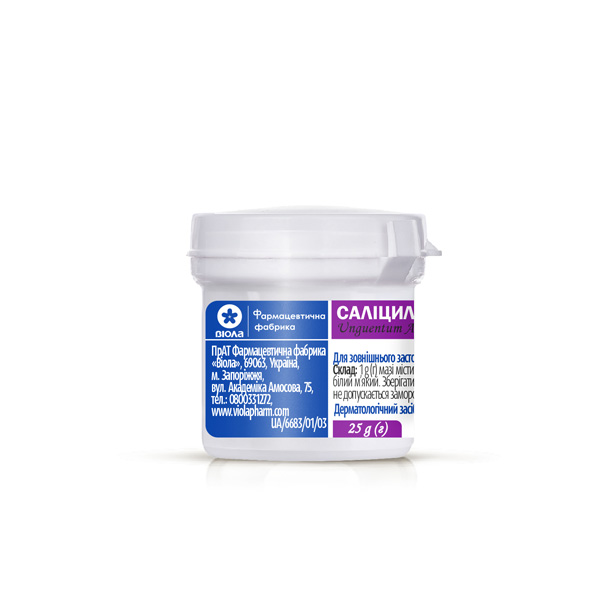
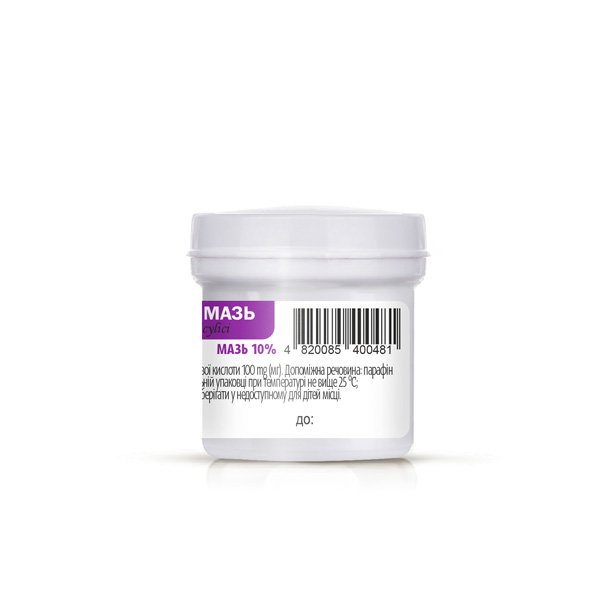


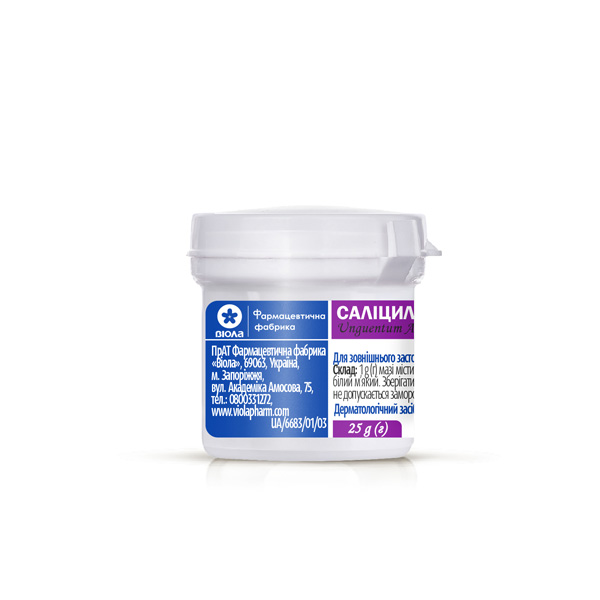
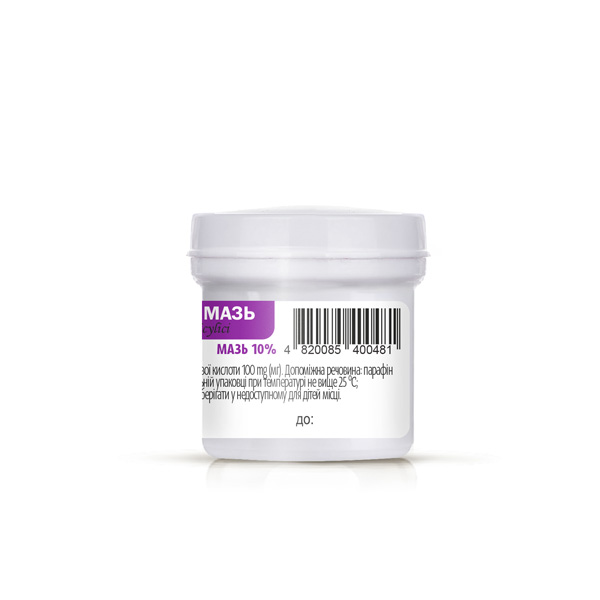
Salicylic ointment 10% 25 g (container)
Treatment of hyperkeratoses of a large area of the body
Adults
Before applying a bandage with salicylic ointment, free the wounds from necrotic masses, rinse with an antiseptic solution
The duration of the course of treatment is from 6 to 20 days.
Increased sensitivity to salicylic acid
Description
Who Salicylic Ointment Is For
A topical dermatology product used when you need to soften and remove excessive thickening of the skin (hyperkeratosis), or to treat calluses and warts locally.
When to Choose Salicylic Ointment
The product is chosen depending on the concentration:
- 2% and 5% — topical treatment of large areas of hyperkeratosis (e.g., psoriasis).
- 10% — topical treatment of warts and calluses.
What Problem the Product Addresses
Salicylic acid acts locally and works “on the skin”:
- Keratoplastic effect at lower concentrations: helps normalize the condition of the keratinized layer.
- Keratolytic effect at higher concentrations: promotes exfoliation of thickened or rough skin.
- Mild antiseptic support: has a weak antiseptic effect.
- Reduction of excessive secretion: suppresses the secretion of sebaceous and sweat glands.
Conditions and Features of Use
- Apply to affected areas 2–3 times a day using a sterile pad, or apply a sterile dressing impregnated with the ointment.
- Before applying a dressing, prepare the area: cleanse it and, if necessary, rinse with an antiseptic solution.
- Do not apply to large areas of skin.
- Do not apply to mucous membranes and avoid contact with the eyes.
- With pronounced inflammation, the 2% ointment may be diluted with white petrolatum (as per instructions) and used less frequently.
- For warts and calluses, use the 10% ointment.
- Approximate course duration: 6–20 days (depends on the condition and response).
Compatibility and Comprehensive Care
- Do not mix with other topical products “in one layer”: combinations may form compounds with unpredictable effects.
- Do not combine topical salicylic acid with oral acetylsalicylic acid (aspirin) or other NSAIDs without medical approval.
- Do not use together with benzoyl peroxide or topical retinoids.
- Salicylic acid may increase skin permeability for other topical medicines.
- If a person is taking methotrexate or antidiabetic medicines (sulfonylurea derivatives), this should be taken into account and reported to a doctor.
Why Choose Salicylic Ointment
- Controlled action on “rough” skin: different concentrations for different needs (2/5% — hyperkeratosis; 10% — calluses and warts).
- Simple application: 2–3 times a day; can be used under a dressing.
- A practical dermatological product for localized problems of excessive keratinization.
- Ukrainian manufacturer: PJSC “Viola Pharmaceutical Factory”.
Salicylic ointment is an effective remedy for hyperkeratosis
The product has an antiseptic effect, promotes exfoliation of keratinized skin cells, is intended for external use. Helps to get rid of unpleasant symptoms of dermatological diseases, as it has a distracting and irritating effect. The active component of the drug is salicylic acid, so it has a weak antiseptic effect.
If you suffer from warts, calluses or other types of hyperkeratosis, try salicylic ointment. Ointment stimulates regenerative processes, thanks to which the skin is restored.
The tool also suppresses the work of sweat and sebaceous glands.
Before using salicylic ointment, it is necessary to remove necrotic masses and treat the skin with an antiseptic. Then a sterile napkin should be impregnated with the medicine and applied to the affected area, and a bandage should be applied on top.
Composition:
active substance: salicylic acid;
1 g of ointment contains salicylic acid 20 mg or 50 mg or 100 mg;
excipient: soft white paraffin.
Medicinal form. Ointment.
Main physicochemical properties: homogeneous ointment of white or light yellow color.
Pharmacotherapeutic group. Dermatological means. Preparations of salicylic acid.
ATX code D02АF.
Pharmacological properties.
Pharmacodynamics.
When applied topically, salicylic acid has a weak antiseptic, as well as an irritating, distracting effect. Suppresses the secretion of sebaceous and sweat glands. In low concentrations, it has a keratoplastic effect, and in high concentrations, it has a keratolytic effect.
Pharmacokinetics.
Salicylic ointment is applied externally, it is practically not absorbed into the systemic bloodstream and does not have a resorptive effect.
Clinical characteristics.
Indication. Ointment 2% and 5%: topical treatment of hyperkeratoses of a large area (for example, psoriasis).
Ointment 10%: topical treatment of warts and corns.
Contraindication. Increased sensitivity to salicylic acid.
Special security measures. Do not allow the drug to get into the eyes, do not apply to the mucous membranes.
Interaction with other medicinal products and other types of interactions.
When used simultaneously with drugs for external use, new compounds with an unpredictable effect may be created, which requires consultation with a doctor.
Topical use of salicylic acid should not be combined with oral use of drugs containing acetylsalicylic acid and other non-steroidal anti-inflammatory drugs. Do not use with benzoyl peroxide and topical retinoids.
Salicylic acid can increase the permeability of the skin to other topical medications and thus increase their absorption into the body. In addition, salicylic acid can increase the undesirable effect of methotrexate and the hypoglycemic effect of oral antidiabetic drugs of sulfonylurea derivatives.
If the patient is taking any other medicines, it is necessary to inform the doctor about it.
Features of application.
Do not apply the drug to large areas of the skin.
Use during pregnancy or breastfeeding.
The safety and clinical effectiveness of the drug during pregnancy or breastfeeding have not been studied.
The ability to influence the speed of reaction when driving vehicles or other mechanisms.
The effect of the drug on the ability to drive vehicles and other mechanisms has not been described.
Method of application and dosage.
Before applying a bandage with salicylic ointment, the wounds should be freed from necrotic masses, washed with an antiseptic solution.
Apply the ointment to the affected areas 2-3 times a day with a sterile napkin or apply a sterile bandage soaked in the ointment to the wounds.
For severe inflammation, dilute 2% the ointment with petrolatum in a ratio of 1:2 – 1:4 and apply 1-2 times a day; after elimination of exfoliation, use other means.
For the treatment of warts and calluses, use 10% ointment.
The duration of the treatment course is from 6 to 20 days.
Children. The experience of use in children is not described.
Overdose. The ointment is intended for external use only. When taken internally, there is heartburn and pain in the esophagus and stomach, repeated vomiting, may be with blood impurities, sometimes – liquid stools with blood impurities. Patients are excited, in a state of euphoria. Dizziness, tinnitus, hearing loss, visual impairment appear. Breathing is loud, accelerated.
Treatment: gastric lavage through a probe, forced diuresis, the appointment of a large amount of alkaline fluid.
When using large doses of the drug, the keratolytic effect and allergic reactions may increase. In this case, the drug must be washed off with water, consult a doctor. The therapy is symptomatic.
Adverse reactions. Rarely – local reactions in the form of itching, burning, skin rashes, dryness, peeling, irritation, contact dermatitis, urticaria.
With long-term use, absorption of the drug into the general circulation and the development of side effects characteristic of salicylates are possible: tinnitus, dizziness, pain in the epigastrium, nausea, vomiting, acidosis, rapid breathing.
In the event of the appearance of any undesirable phenomena, it is necessary to consult a doctor!
Expiration date. 3 years.
Storage conditions. Store in the original packaging at a temperature not higher than 25 °C; freezing is not allowed. Keep out of the reach of children.
Packaging. Containers of 25 g. 20 g or 25 g in tubes. 1 tube in a pack or without a pack.
Leave category. Without a prescription.
Producer. PrJSC Pharmaceutical factory “Viola”.
The location of the manufacturer and its address of the place of business.
69063, Ukraine, Zaporozhye, Akademika Amosova, 75.
The applicant PrJSC Pharmaceutical factory “Viola”.
Location of the applicant.
69063, Ukraine, Zaporozhye, Akademika Amosova, 75.