


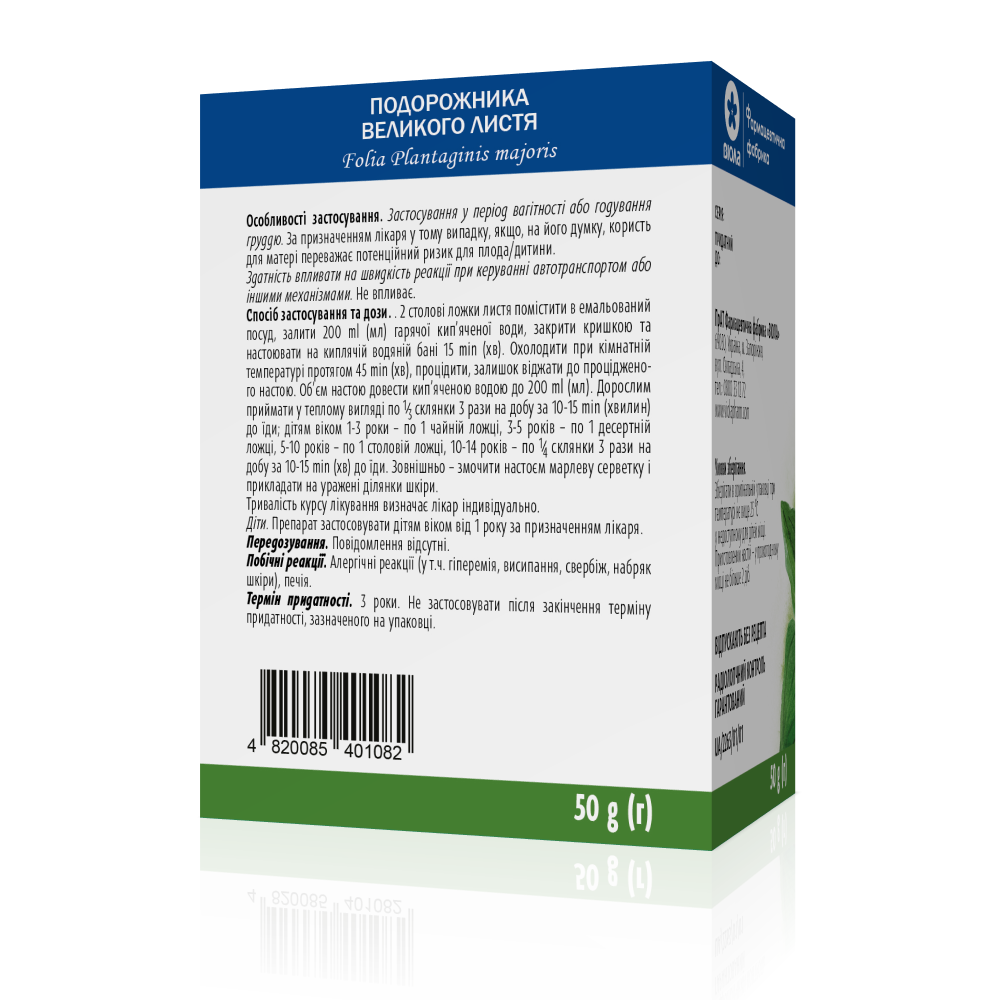


Plantain leaves 50 g
Diseases of the respiratory tract (bronchitis, whooping cough, pneumosclerosis, pulmonary tuberculosis), gastrointestinal diseases (gastritis with low acidity, gastric and duodenal ulcers, enteritis and enterocolitis) are part of complex therapy. Apply externally as a wound healing agent.
Use during pregnancy or breastfeeding.
As prescribed by a physician if, in his opinion, the benefit to the mother outweighs the potential risk to the fetus/child.
Place 2 tablespoons of leaves in an enamel bowl, pour 200 ml of hot boiled water, close the lid and leave in a boiling water bath for 15 minutes. Cool at room temperature for 45 minutes, strain, squeeze the rest to the filtered infusion. Bring the volume of infusion to 200 ml with boiled water.
The duration of treatment is determined by the doctor individually.
Hypersensitivity to the biologically active substances of the drug. Hyperacid gastritis, gastric ulcer with high acidity; increased blood clotting and tendency to thrombosis, reflux esophagitis.
Description
Composition:
active ingredient: large-leaf plantain (Folia Plantaginis majoris);
1 pack contains plantain of large leaves (Folia Plantaginis majoris) – 50 g; 1 filter bag contains 1.5 g of large-leaf plantain (Folia Plantaginis majoris).
Medicinal form. Leaf.
Basic physical and chemical properties:
Crushed raw materials: pieces of leaves of various shapes that pass through a sieve with holes with a diameter of 7 mm. The color is green or brownish-green. The smell is faint. The taste is slightly bitter;
Coarse powder: pieces of leaves of various shapes that pass through a sieve with holes with a diameter of 2 mm. The color is green or brownish-green. The smell is faint. The taste is slightly bitter.
Pharmacotherapeutic group. Expectorants. ATX code R05C A.
Pharmacological properties.
Pharmacodynamics.
Biologically active substances of the drug have expectorant, anti-inflammatory, analgesic, hemostatic, wound healing, bacteriostatic effects; enhance the functional activity of the epithelium of the respiratory tract, promote the secretion and evacuation of mucus from them, reduce cough; increase the secretion of gastric juice, increase acidity; They help to cleanse wound and ulcer surfaces from purulent bacteria, enhance the processes of granulation of the surfaces of affected tissues.
Pharmacokinetics. Not studied.
Clinical characteristics.
Indication.
Diseases of the respiratory tract (bronchitis, whooping cough, pneumosclerosis, pulmonary tuberculosis), gastrointestinal diseases (gastritis with low acidity, gastric and duodenal ulcers, enteritis and enterocolitis) are part of complex therapy. Apply externally as a wound healing agent.
Contraindication.
Hypersensitivity to the biologically active substances of the drug. Hyperacid gastritis, gastric ulcer with high acidity; increased blood clotting and tendency to thrombosis, reflux esophagitis.
Interaction with other medicinal products and other types of interactions.
Do not use simultaneously with antitussive drugs and drugs that reduce sputum production.
Features of application.
Use during pregnancy or breastfeeding.
As prescribed by a physician if, in his opinion, the benefit to the mother outweighs the potential risk to the fetus/child.
The ability to influence the speed of reaction when driving vehicles or other mechanisms. Does not affect.
Method of application and dosage.
Place 2 tablespoons of leaves in an enamel bowl, pour 200 ml of hot boiled water, close the lid and leave in a boiling water bath for 15 minutes. Cool at room temperature for 45 minutes, strain, squeeze the rest to the filtered infusion. Bring the volume of infusion to 200 ml with boiled water. Adults take warm 1/3 cup 3 times a day 10-15 minutes before meals; Children aged 1-3 years – 1 teaspoon, 3-5 years old – 1 dessertspoon, 5-10 years old – 1 tablespoon, 10-14 years old – 1/4 cup 3 times a day 10-15 minutes before meals.
Place 3 filter bags in a glass or enamel container, pour 200 ml of boiling water, close and infuse for 15 minutes. Adults take warm 1/2 cup 4 times a day 10-15 minutes before meals; Children aged 1-3 years – 1 dessertspoon, 3-5 years old – 2 dessertspoons, 5-10 years old – 2 tablespoons, 10-14 years old – 1/3-1/2 cup 3 times a day 10-15 minutes before meals.
Externally, moisten a gauze napkin with the infusion and apply to the affected areas of the skin.
The duration of treatment is determined by the doctor individually.
Children.
The drug is used in children over 1 year of age as prescribed by a doctor.
Overdose.
There are no messages.
Adverse reactions.
Allergic reactions (including hyperemia, rash, itching, swelling of the skin), heartburn.
Expiration date. 3 years.
Do not apply after the expiration date indicated on the package.
Storage conditions.
Store in the original packaging at a temperature not exceeding 25 °C out of the reach of children. Prepared infusion – in a cool place for no more than 2 days.
Packaging.
50 g in bags with enclosure in a pack; 1.5 g in filter bags, 20 filter bags in a pack.
Leave category. Without a prescription.
Producer. PrJSC Pharmaceutical factory “Viola”.
The location of the manufacturer and its address of the place of business.
69050, Ukraine, Zaporozhye, Skladska, 4.
The applicant PrJSC Pharmaceutical factory “Viola”.
Location of the applicant.
69063, Ukraine, Zaporozhye, Akademika Amosova, 75.
Instructions
Video
Reviews
Articles
-
 Coltsfoot Herb: Medicinal Properties and Uses
Coltsfoot is a plant of the Asteraceae family. It is the first to appear in spring and can grow on roadsides, meadows, forests and vacant lots.
Read more » -
 Plantain leaves: useful properties and contraindications, features of use
Plantain is a perennial herbaceous plant from the plantain family. It is widely distributed in Europe, Asia, North America and Africa. Plantain grows on roadsides, meadows, fields and in gardens.
Read more » -
 What herbs were in the medieval doctor’s first-aid kit
In Europe of the XIII-XVI centuries, a medieval doctor relied on knowledge of herbs, the heritage of ancient treatises and the experience of local herbalists: his first-aid kit included dozens of medicinal plants, from which infusions, decoctions, ointments and powders were prepared.
Read more »