

- What is a cough
- Dry cough: why it occurs and what can help
- Wet cough: what is important to consider
- What to do if the cough does not go away for a long time
- What can help with cough at home
- What medicines can be used for coughing
- Dietary supplements and mucosal softeners
- Cough in children under 12 years of age: rules for the safe use of medicines
- When you need to see a doctor for coughing
- Conclusion
- Frequently Asked Questions
The material is for informational purposes only and does not replace a doctor’s consultation. Cough is a symptom, not a separate diagnosis. The choice of treatment depends on its cause, nature, duration, the person’s age, concomitant diseases, and other symptoms. Before using medicines, it is necessary to read the instructions for medical use and take into account indications, contraindications, and age restrictions.
Coughing helps clear mucus and foreign particles from the airways, but it can occur in many different conditions, from acute respiratory infections to allergies, bronchial asthma, postnasal drip, or gastroesophageal reflux. That is why there is no single universal cough remedy.
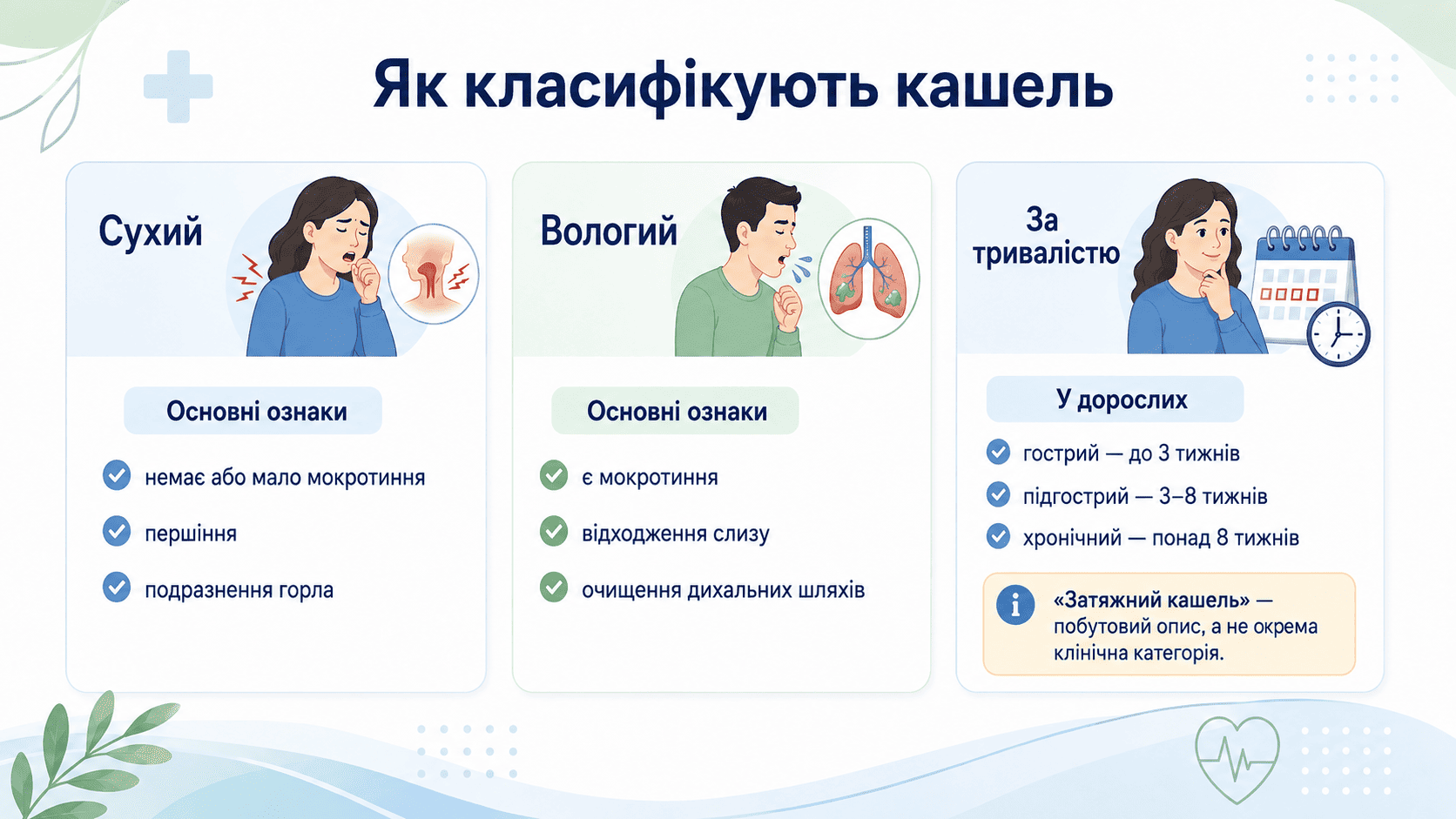
To correctly assess the symptom, it is important not to mix the different characteristics of cough. Dry and wet coughs are distinguished primarily by the presence of phlegm, while acute, subacute, and chronic coughs are distinguished primarily by their duration.


What is a cough
Dry and wet cough
A dry cough is not accompanied by sputum discharge, or the amount of mucus is insignificant. It can be irritating, paroxysmal, and accompanied by a tickling sensation, dry throat, or hoarseness.
A wet, or productive, cough is accompanied by the formation and discharge of sputum. In this case, the cough reflex performs an important function — it helps clear the airways.
At the same time, the nature of the cough does not determine its cause. For example, during a respiratory infection, the cough may be dry at first and later accompanied by phlegm.
Acute, subacute, and chronic cough
Cough is also classified according to duration. For adults, the following division is used in the CHEST clinical guidelines:
- acute cough — less than 3 weeks;
- subacute cough — from 3 to 8 weeks;
- chronic cough — more than 8 weeks.
The phrase “lingering cough” is often used in everyday life to describe a cough that does not go away for a long time, but this is not a separate standardized clinical category with a single time limit.
In children, the approach to cough duration differs from that used in adults. In particular, in pediatric recommendations, a cough that lasts more than 4 weeks is often considered chronic. Therefore, the adult limit of 8 weeks should not be automatically applied to children.
Dry cough: why it occurs and what can help
A dry cough often appears at the beginning of an acute respiratory infection, when the mucous membrane of the respiratory tract is irritated, but there is not yet a significant amount of phlegm. For some time, it can persist after an infection.
Dry cough can also be caused by dry air, tobacco smoke, vaping, dust, pungent odors, or cold air. In other cases, the cough may be associated with allergies, bronchial asthma, postnasal drip, gastroesophageal reflux, or taking certain medications.
What is the strategy for dry cough
The main task is not to “convert a dry cough into a wet one,” but to understand its cause and reduce irritation of the respiratory tract.
If the cough occurs against the background of an acute respiratory infection and there are no dangerous symptoms, sufficient fluid intake, comfortable temperature and humidity, room ventilation, and elimination of irritants can help.
Expectorants do not need to be used automatically just because the cough is dry. If there is no sputum, such drugs may not meet the purpose of treatment.
Antitussives affect the cough reflex and can only be used in appropriate situations, taking into account age, the cause of cough, contraindications, and other drugs that the person is taking. If the cough is debilitating, interferes with sleep, or recurs for a long time, it is advisable to consult a doctor.
Wet cough: what is important to consider
With a wet cough, phlegm is formed, which the body removes with the help of the cough reflex. Therefore, the main goal is not to eliminate the cough at any cost, but to ensure normal clearing of the respiratory tract and determine the cause of sputum formation.
What can help with wet cough
In the absence of medical restrictions, it is important to drink enough fluids, ventilate the room, maintain comfortable humidity, and avoid tobacco smoke and other irritants.
If the sputum is thick or difficult to discharge, a doctor or pharmacist may recommend a remedy according to the specific indications. At the same time, mucolytics and expectorants are not a universal treatment for any acute cough. For example, NICE does not recommend the routine use of mucolytics for acute cough associated with an upper respiratory tract infection or acute bronchitis.
Antitussive drugs should not be used independently when there is a significant amount of phlegm, as suppression of the cough reflex can make it difficult to clear the airways. Also, without the recommendation of a specialist, you should not combine drugs with opposite effects.
Is sputum color important?
Sputum can be clear, whitish, yellow or greenish, thick or liquid. By itself, its color does not reliably determine the cause of the cough and does not automatically mean that a person needs an antibiotic.
Blood impurities, severe shortness of breath, chest pain, high fever, or a sharp deterioration in general condition require special attention. With such symptoms, a medical evaluation is necessary.
What to do if the cough does not go away for a long time
A cough after an acute respiratory infection does not always go away at the same time as a runny nose, fever, or sore throat. In some people, it can persist for some time due to increased sensitivity of the respiratory tract.
However, a prolonged cough should not be treated for months by repeatedly replacing syrups. If the symptom does not subside, recurs, or turns into a subacute or chronic cough, it is important to determine its cause.
Possible causes of prolonged cough in adults include post-infectious cough, bronchial asthma, postnasal drip, gastroesophageal reflux, smoking or vaping, side effects of certain medications, and diseases of the respiratory system.
It is important to tell the doctor when the cough began, whether it was preceded by a respiratory infection, whether there is phlegm, at what time of day the symptom worsens, and whether it is associated with physical activity, food, body position, contact with allergens, or cold air.
Treatment in such a situation should be aimed primarily at the established cause of the cough.
What can help with cough at home
With an uncomplicated acute cough, simple measures that reduce irritation of the mucous membranes and help a person get through the period of illness more comfortably play an important role.
Sufficient fluid intake maintains normal hydration of the mucous membranes. Drinks should be at a comfortable temperature: very hot liquids can further irritate the throat.
For adults and children over 1 year of age, honey can be one of the options for symptomatic cough relief, if there are no allergies or other contraindications. Children under 1 year of age should not be given honey.
Dry and overheated air can aggravate an irritating cough. Therefore, it is worth regularly ventilating the room, maintaining a comfortable temperature, and avoiding excessive dryness of the air.
It is also important to avoid tobacco smoke, secondhand smoke, vapes, dust, aerosols, and strong odors.
Hot steam inhalation should not be considered a universal treatment. It poses a risk of burns, especially in children.
What medicines can be used for coughing
The choice of drug depends not only on whether the cough is dry or wet. It is necessary to take into account the cause of the symptom, its duration, the person’s age, the nature of the sputum, concomitant diseases, and other drugs.
Expectorants
Expectorant drugs are used in accordance with their indications, in particular in cases where the cough is accompanied by sputum and difficulty discharging it.
Herbal medicines in this group may include preparations based on marshmallow root, ivy, plantain, or licorice. Depending on the specific medicinal product, indications, permissible age, method of administration, and contraindications may vary.
Therefore, Marshmallow root syrup, Ivy syrup, Plantain syrup, Licorice root syrup, and other herbal preparations should not be taken as interchangeable remedies “for any cough.” Before use, you need to be guided by the instructions for the selected drug.
Pertussin is also a drug with its own indications, composition, and restrictions. When using it, you need to take into account the contraindications and features of use indicated in the instructions.
Mucolytics
Mucolytic agents change the properties of sputum and are used according to appropriate indications. They do not need to be automatically used for every cold or every wet cough.
If the cough is accompanied by a lot of phlegm, shortness of breath, high fever, or a general deterioration in condition, it is more advisable to determine the cause of the symptoms first.
Antitussive drugs
Antitussive drugs reduce the cough reflex. Their use can be considered for certain types of dry, debilitating cough, but the choice of a specific remedy must correspond to the indications and instructions.
With a productive cough with phlegm, self-suppression of the cough reflex may be inappropriate. Also, without a doctor’s recommendation, you should not take antitussive and expectorant drugs at the same time.
Antibiotics
Antibiotics are not directly “cough remedies.” Most cases of acute cough associated with upper respiratory tract infections are of viral origin. NICE notes that acute cough is usually self-limiting and in most cases does not require antibiotics.
Antibacterial drugs are used only when there are medical indications for this.
Dietary supplements and mucosal softeners
It is important to separate dietary supplements from medicines. They are not intended for the treatment of bronchial asthma, pneumonia, bronchitis, allergies, or other diseases that may be accompanied by coughing.
For example, Icelandic moss can be used as a dietary supplement for additional support for dry mucous membranes, tickling in the throat, or hoarseness according to consumer information. It is not a drug and is not a substitute for diagnosing or treating the cause of cough.
If a dry cough is associated with asthma, an allergic reaction, reflux, or another medical condition, treatment of the underlying condition is necessary, not just symptomatic softening of the throat.
Cough in children under 12 years of age: rules for the safe use of medicines
Children are not “little adults,” so cough and cold medicines should be used with extreme caution. Age restrictions for different medicines can vary significantly.
Before giving your child any cough or cold medicine, you need to check whether it is approved for their age, what dose is provided for in the instructions, and how often the remedy can be used.
You cannot use an adult dose or independently calculate “half of an adult dose” for a child. For liquid dosage forms, you should use the measuring device provided by the manufacturer, not a regular kitchen spoon.
If several cold medicines are used at the same time, it is necessary to check their composition. Different trade names may contain the same active ingredients, which is why there is a risk of unintentional overdose.
You should not independently combine an antitussive drug with an expectorant or mucolytic agent.
International regulators also pay special attention to the use of over-the-counter cough and cold medicines in children. For example, the British MHRA does not recommend a number of such drugs for children under 6 years of age, and for the age of 6–12 years, they are used with pharmaceutical advice. These recommendations do not replace the Ukrainian instructions for a particular drug, but emphasize the need for special caution in this age group.
Honey should not be given to a child under 1 year of age. Lozenges and pastilles should also be appropriate for the child’s age due to the risk of choking.
If the child’s cough persists for a long time, recurs, or is accompanied by wheezing or nighttime attacks, the child should be examined by a doctor.
When you need to see a doctor for coughing
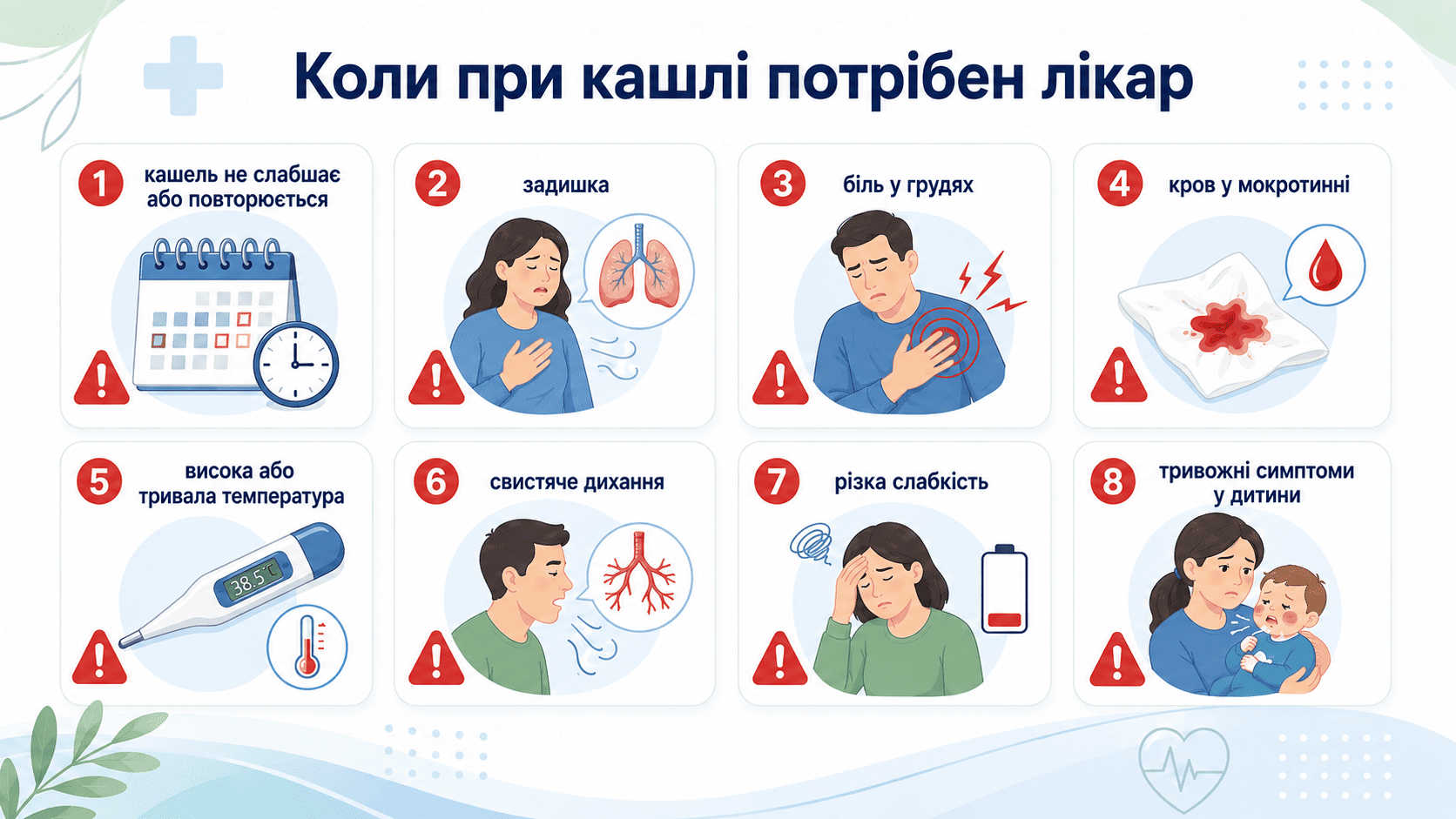
A doctor’s consultation is needed if the cough does not subside within the expected period, turns into a subacute or chronic cough, regularly recurs, or significantly disrupts sleep and daily life.
Do not postpone medical care if you have:
- difficulty breathing or severe shortness of breath;
- chest pain;
- blood in the sputum;
- blue lips or skin;
- pronounced wheezing;
- high or prolonged fever;
- severe weakness or significant deterioration in general condition.
For children, additional warning signs are lethargy, refusal to drink, signs of dehydration, and noticeable difficulty breathing.
In such situations, the main task is not to choose a stronger syrup, but to determine the cause of the cough in a timely manner.
Conclusion
Dry and wet coughs characterize the presence or absence of phlegm, and acute, subacute, and chronic coughs characterize the duration of the symptom. These are different characteristics that must be evaluated separately.
With a dry, irritating cough, it is important to reduce exposure to irritants and determine the cause. With a wet cough, you need to take into account the role of the cough reflex in clearing the airways and not suppress it without indications. If the cough does not go away for a long time, treatment should be aimed primarily at establishing the cause.
Medicines should be used in accordance with the indications and instructions, and when treating children, age restrictions and dosage rules should be observed especially carefully.
Frequently Asked Questions
What is the difference between a dry cough and a wet cough?
With a dry cough, there is no or very little sputum. A wet cough is accompanied by the formation and discharge of sputum.
Do I need to convert a dry cough to a wet cough?
No. The goal of treatment depends on the cause of the cough. In case of allergies, asthma, reflux, or irritation of the mucous membrane, it is not necessary to artificially “convert” the cough into a wet one.
What is a lingering cough?
“Lingering cough” is a general description of a cough that does not go away for a long time, not a separate standardized clinical category. In adults, acute, subacute, and chronic coughs are distinguished according to duration.
Can you suppress a wet cough?
When coughing with phlegm, you should not independently use drugs that suppress the cough reflex. The choice of remedy depends on the specific situation.
Do I need antibiotics for coughing?
Not for every cough. Antibiotics do not work on viral infections and are prescribed only if there are appropriate medical indications.
What can help with coughing at home?
Sufficient fluid intake, comfortable humidity and air temperature, ventilation, and avoiding tobacco smoke, vapes, dust, and other irritants can help.
When does a prolonged cough need to be examined?
If the cough does not subside, recurs, lasts for several weeks, or is accompanied by shortness of breath, chest pain, blood in the sputum, or other alarming symptoms, a doctor’s consultation is necessary.
References
- Irwin R.S. et al. Classification of Cough as a Symptom in Adults and Management Algorithms: CHEST Guideline and Expert Panel Report. CHEST.
- NICE. Cough (acute): antimicrobial prescribing. Guideline NG120.
- European Respiratory Society. ERS guidelines on the diagnosis and treatment of chronic cough in adults and children.
- Medicines and Healthcare products Regulatory Agency. Over-the-counter cough and cold medicines for children.
Author: Natalia Kandybey, Candidate of Pharmaceutical Sciences, Quality Director of PJSC Pharmaceutical Factory “VIOLA”
Subscribe to our pages on social networks: Facebook and Instagram.


