
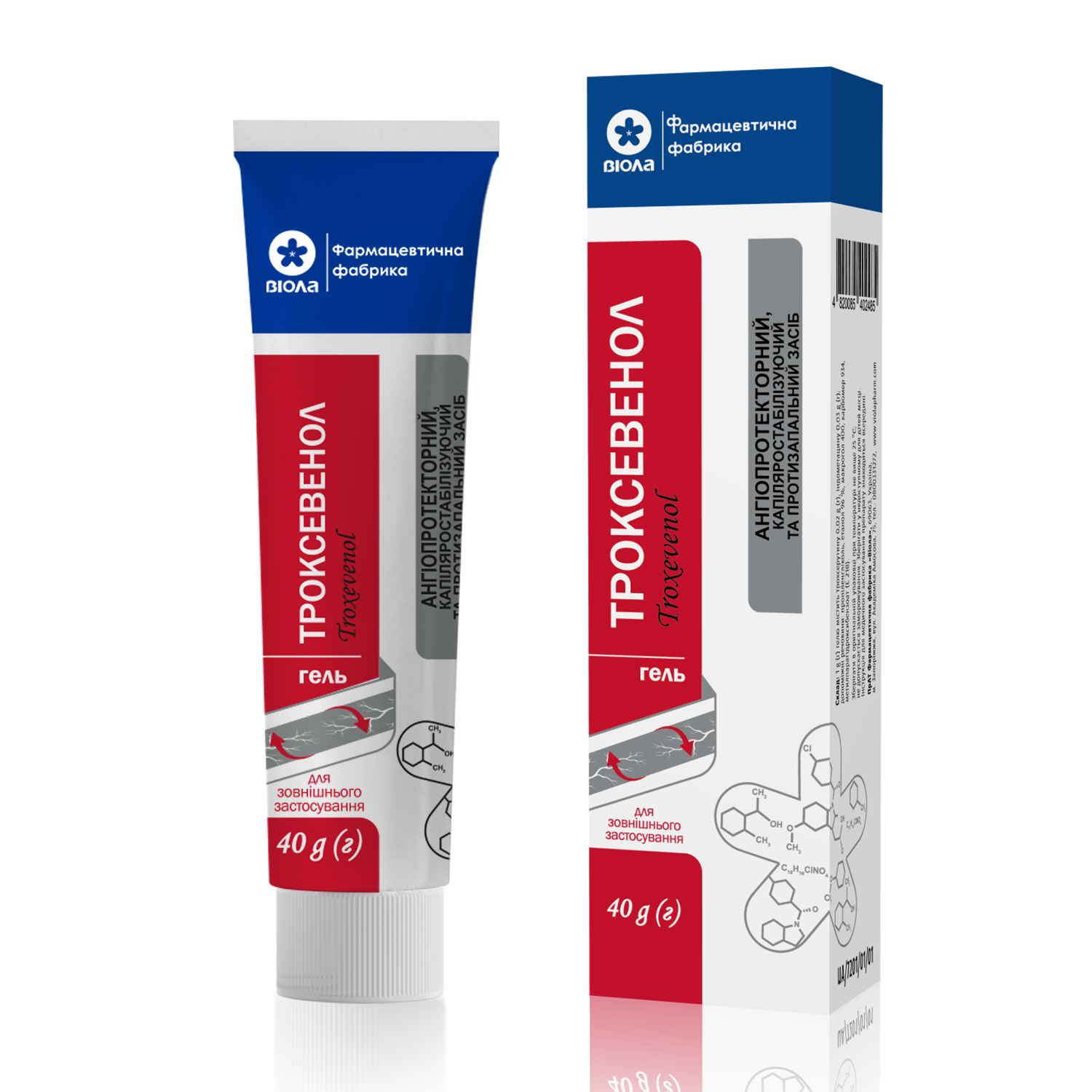


Troxevenol gel 40 g
Symptomatic treatment of venous insufficiency, varicose veins, superficial thrombophlebitis, phlebitis, condition after phlebitis; in the complex therapy of hemorrhoids; rheumatism of soft tissues – tendovaginitis, bursitis, fibrositis, periarthritis; edema after surgical interventions; bruises, dislocations, sprains
Adults and children over 14 years old
Pregnant
Externally
Adults and children over 14 years old
Apply the gel in a thin layer of 4-5 cm on the damaged areas and rub easily 3-4 times a day
10 days
The drug contains propylene glycol, which can cause skin irritation, and methyl parahydroxybenzoate, which can cause allergic reactions
Description
Who Troxevenol is suitable for
A combined gel for external use in venous insufficiency, swelling, pain, and inflammation in soft tissues. Suitable for adults and adolescents from 14 years old when local anti-inflammatory, analgesic, anti-edematous, and venotonic action is needed.
When to choose Troxevenol
The medicine is used for symptomatic treatment in cases of:
- venous insufficiency;
- varicose veins;
- superficial thrombophlebitis, phlebitis, and post-phlebitic condition;
- hemorrhoids — as part of complex therapy;
- soft tissue rheumatism: tendovaginitis, bursitis, fibrositis, periarthritis;
- swelling after surgical interventions;
- bruises, dislocations, and sprains.
What problem the medicine solves
Troxevenol combines the action of troxerutin and indomethacin, so it works in several directions at once:
- Anti-inflammatory action: indomethacin inhibits prostaglandin synthesis and helps reduce inflammation.
- Pain relief: when applied locally, the medicine may reduce pain in the affected area.
- Anti-edematous action: helps reduce tissue swelling.
- Venotonic and angioprotective action: troxerutin reduces capillary permeability, increases capillary resistance, and improves tissue trophism in venous insufficiency.
- Recovery support: in injuries of the musculoskeletal system, it may shorten the period of functional rehabilitation.
Conditions and features of use
- Use externally only.
- Apply a 4–5 cm strip of gel in a thin layer to the affected areas and rub in gently.
- Use 3–4 times a day.
- The total daily dose should not exceed 20 cm of gel.
- The duration of treatment is no more than 10 days.
- Apply only to intact skin.
- Avoid contact of the gel with mucous membranes, open wounds, and eyes.
- If treatment lasts more than 10 days, monitoring of the leukocyte formula and platelet count is required.
Compatibility and comprehensive care
- The medicine should not be used simultaneously with other nonsteroidal anti-inflammatory drugs and corticosteroids.
- The medicine should be used with special caution in allergic diseases and reactions, impaired liver or kidney function, application to large areas of skin, and in the presence of a gastric ulcer.
- If the gel accidentally gets into the eyes, on mucous membranes, or open wounds, it should be rinsed off with plenty of distilled water or 0.9% sodium chloride solution.
- If itching, redness, rash, burning, or other adverse reactions occur, use should be stopped and a doctor should be consulted.
Why choose Troxevenol
- Combined composition: troxerutin + indomethacin.
- Combines venotonic, angioprotective, anti-inflammatory, analgesic, and anti-edematous effects.
- Suitable for venous insufficiency, varicose veins, swelling, and soft tissue injuries.
- Convenient gel form for local application.
- Ukrainian manufacturer: PJSC “Pharmaceutical Factory “Viola”.
The combined drug reduces the permeability of capillaries, has an anti-inflammatory and venotonic effect.
Troxevenol eliminates swelling, helps to get rid of pain in venous insufficiency and other vascular diseases. Shortens the rehabilitation period for injuries of the musculoskeletal system.
If you suffer from venous insufficiency, phlebitis, thrombophlebitis, varicose veins, periarthritis, bursitis or tendovaginitis, try Troxevenol gel.
It will also come in handy for bruises, dislocations, sprains and swelling after surgical interventions.
The active components included in the preparation contribute to the reduction of edema and improve tissue trophicity, have an analgesic and anti-inflammatory effect.
Troxevenol can also be used to treat external hemorrhoids.
Method of application – The drug should be used externally. It is necessary to apply the gel in a thin layer 3-4 times a day, rubbing into intact skin.
Composition:
active substances: troxerutin, indomethacin;
1 g of gel contains 20 mg (0.02 g) troxerutin, 30 mg (0.03 g) indomethacin;
excipients: propylene glycol, ethanol 96%, macrogol 400, carbomer 934, methyl parahydroxybenzoate (E 218).
Medicinal form. Gel.
Main physicochemical properties: homogeneous, yellow, transparent or slightly opalescent gel.
Pharmacotherapeutic group.
Capillary stabilizing means. Troxerutin, combinations. ATX code C05S A54.
Pharmacological properties.
Pharmacodynamics.
Troxevenol is a combined drug for local use. Indomethacin has a pronounced anti-inflammatory, analgesic and anti-edematous effect due to inhibition of prostaglandin synthesis by reverse blockade of COX enzyme, prevents platelet aggregation. When used locally, it reduces pain, swelling and shortens the period of functional rehabilitation in case of injuries of the musculoskeletal system. Indomethacin exhibits more pronounced anti-inflammatory activity compared to salicylates and phenylbutazone.
Troxerutin belongs to bioflavonoids and is a mixture of hydroxyethyl derivatives of rutoside, in which trihydroxyethyl rutoside predominates. It exhibits angioprotective activity, reduces the permeability of capillaries and exerts a venotonic effect. Eliminates the vasodilator effect of histamine, bradykinin and acetylcholine, has an anti-aggregate and anti-inflammatory effect on paravenous tissues, increases the resistance of capillaries. Reduces swelling of tissues, improves their trophism in pathological changes associated with venous insufficiency.
Pharmacokinetics.
The gel base of the drug ensures complete solubility of active components and their penetration into inflamed tissues and synovial fluid. Indomethacin binds to blood plasma proteins by more than 90% and is subject to biotransformation in the liver by O-demethylation and N-deacetylation with the formation of inactive compounds. Indomethacin is excreted in urine (60%), bile and feces (30%). Penetrates into breast milk.
Most of the resorbed tri-, di- and polyhydroxyethyl rutosides are excreted with bile, a much smaller part – with urine. Tetrahydroxyethylrutoside is mainly excreted in the urine.
Clinical characteristics.
Indication.
Symptomatic treatment of venous insufficiency, varicose veins, superficial thrombophlebitis, phlebitis, condition after phlebitis; in the complex therapy of hemorrhoids; rheumatism of soft tissues – tendovaginitis, bursitis, fibrositis, periarthritis; edema after surgical interventions; bruises, dislocations, sprains.
Contraindication.
Hypersensitivity to any components of the drug or to nonsteroidal anti-inflammatory drugs. The drug is contraindicated for patients with bronchial asthma.
Interaction with other medicinal products and other types of interactions.
The drug should not be used simultaneously with other non-steroidal anti-inflammatory drugs (potentiation of the effect) and corticosteroids (possibility of ulcerogenic effect).
Features of application.
The gel is intended for external use only.
Troxevenol is applied only to intact skin. It is necessary to avoid getting the gel on the mucous membranes, open surfaces of wounds and in the eyes.
If the duration of treatment is more than 10 days, it is necessary to determine the leukocyte formula and the number of platelets.
Do not exceed the recommended dose.
As with other drugs containing non-steroidal anti-inflammatory agents, the drug should be used with extreme caution in patients with allergic diseases and reactions, in case of impaired liver and kidney function, when applied to large areas of the skin, as well as in the presence of a stomach ulcer.
Use during pregnancy or breastfeeding.
There is no clinical experience confirming the safety of using the drug during pregnancy, so prescribing the drug is possible only if the expected therapeutic effect for the mother outweighs the potential risk to the fetus. Due to the fact that indomethacin penetrates into breast milk, it is not recommended to use the drug during breastfeeding.
The ability to influence the speed of reaction when driving vehicles or other mechanisms.
Does not affect.
Method of application and dosage.
Externally. A column of gel 4-5 cm long is applied in a thin layer to the damaged areas and rubbed easily 3-4 times a day. The total daily dose should not exceed 20 cm of gel. The duration of treatment is no more than 10 days.
Children.
It is not recommended to use the drug for children under 14 years of age, given the lack of sufficient clinical experience.
Overdose.
When using the drug locally, overdose has not been noted, however, long-term treatment (more than 10 days) requires monitoring to detect possible systemic effects – hepatotoxicity, severe headache, hemorrhages, as well as laboratory blood tests (monitoring of the leukocyte formula and the number of platelets). In case of accidental ingestion of the drug, burning sensations in the oral cavity, salivation, nausea, vomiting are possible. In this case, rinsing of the oral cavity and stomach is indicated, and if necessary, symptomatic treatment. In case of contact with the eyes, mucous membranes and open wounds, local irritation is observed – lacrimation, hyperemia, burning, pain. Wash the gel with a large amount of distilled water or 0.9% sodium chloride solution until the symptoms completely disappear or significantly decrease.
Adverse reactions.
Local reactions: possible appearance of symptoms of hypersensitivity on the part of the skin – contact dermatitis, itching, redness, rash, feeling of heat and burning in the area of application.
Systemic reactions: very rarely, with long-term use on large areas of the body, the appearance of side effects is possible:
from the side of the digestive tract – nausea, vomiting, pain in the stomach area, increased levels of liver enzymes;
from the side of the immune system – symptoms of increased sensitivity (anaphylaxis, bronchial asthma attack, angioedema).
The drug contains propylene glycol, which can cause skin irritation, and methyl parahydroxybenzoate, which can cause allergic reactions.
If any unwanted reactions occur, you should stop using the drug and consult a doctor.
Expiration date. 2 years.
Storage conditions.
Store in the original packaging at a temperature not higher than 25 °C; freezing is not allowed. Keep out of the reach of children.
Packaging.
40 g in tubes. 1 tube in a pack or without a pack.
Leave category. Without a prescription.
Producer. PrJSC Pharmaceutical factory “Viola”.
The location of the manufacturer and its address of the place of business.
69063, Ukraine, Zaporozhye, Akademika Amosova, 75.
The applicant PrJSC Pharmaceutical factory “Viola”.
Location of the applicant.
69063, Ukraine, Zaporozhye, Akademika Amosova, 75.
Instructions
Reviews
Articles
-
 Restoration of damaged muscles after exercise
Muscle pain, which almost everyone experiences after intense or unfamiliar exercise, often reaching a peak in a day or two, is known by the name of delayed muscle pain syndrome (English: delayed muscle pain syndrome). Delayed onset muscle soreness, DOMS), a colloquial term is a serfdom.
Read more » -
 Heaviness in the legs and varicose veins: causes, stages, treatment and prevention
Varicose veins are a pathological condition in which the veins lose their normal functionality, become excessively dilated, tortuous and visible under the skin.
Read more »