


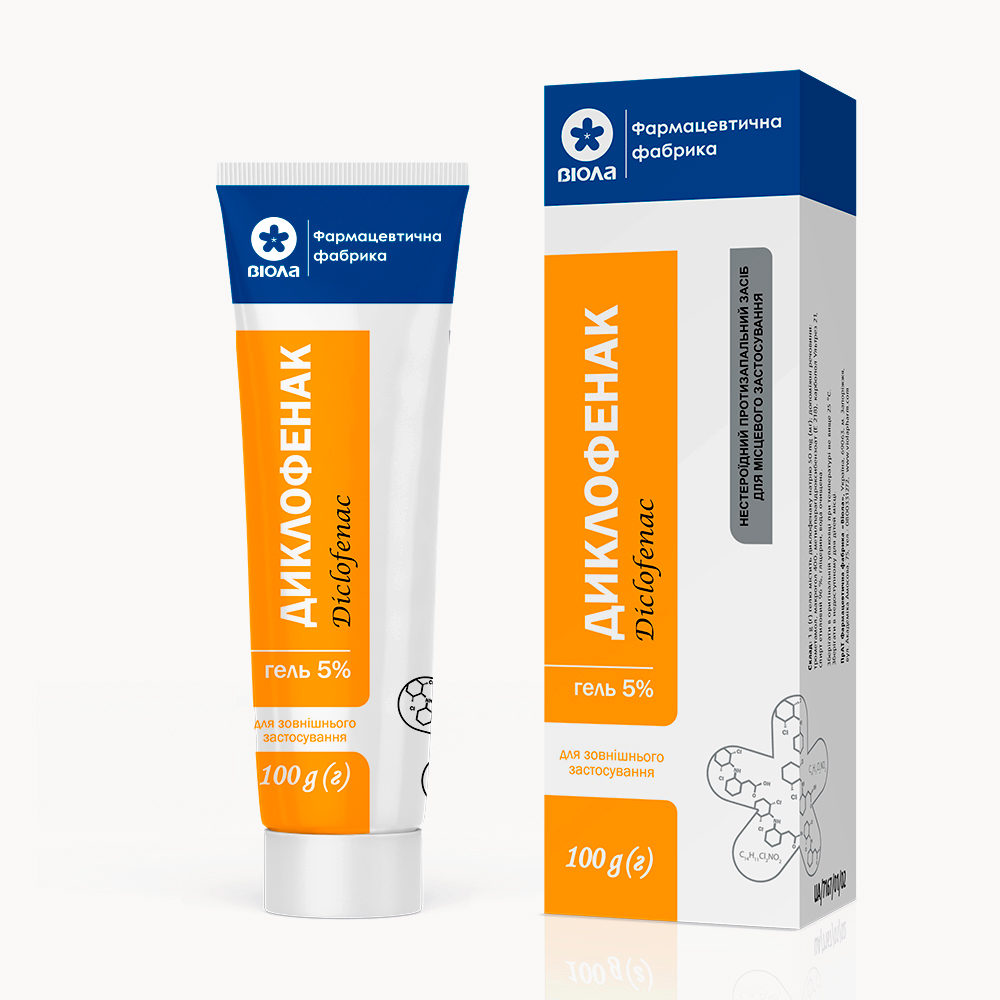
Diclofenac gel 5% 100 g
Local treatment of pain and inflammation of rheumatic or traumatic origin:
joints;
ligaments and tendons;
muscles
Use with caution when taking oral non-steroidal anti-inflammatory drugs
Adults
Apply 3–4 times daily, gently rubbing into the skin
Depends on the condition and response to treatment, but should not exceed 14 consecutive days
Hypersensitivity to the product’s components, allergic reactions to NSAIDs, third trimester of pregnancy, pediatric age
Description
Who Diclofenac Gel 5% is suitable for
A non-steroidal anti-inflammatory drug (NSAID) for topical use to relieve pain and inflammation in the joints and muscles. Suitable for adults for application to intact (unbroken) skin in conditions of rheumatic or traumatic origin. Contraindicated for children.
When to choose Diclofenac
The gel is used for local treatment of pain and inflammation of joints, muscles, ligaments, and tendons of rheumatic or traumatic origin.
What problem the medicine solves
Diclofenac has pronounced local anti-rheumatic, analgesic, and anti-inflammatory properties:
- Reduces pain and inflammation: inhibits prostaglandin synthesis — mediators of pain and inflammation.
- Reduces swelling: helps decrease tissue swelling during inflammation.
- Supports functional recovery: shortens the period needed to restore the function of injured joints, ligaments, tendons, and muscles in trauma/rheumatic conditions.
- Acts locally: accumulates in the skin and is gradually released into adjacent tissues, reaching deeper inflamed tissues (including joints).
Conditions and specific features of use
- Apply 3–4 times daily, gently rubbing into the skin.
- The amount depends on the affected area: 2–4 g of gel (about the size of a cherry or a walnut) is sufficient for an area of 400–800 cm².
- Wash hands after application unless the hands are the treated area.
- Apply only to intact skin.
- Do not apply to open wounds, infected or injured skin, areas affected by eczema, or to mucous membranes.
- Avoid contact with eyes and mucous membranes.
- Do not use under an occlusive dressing.
- Use under a non-occlusive dressing is allowed; in case of ligament sprain, the affected area may be wrapped with a bandage.
- If any skin rash appears, stop using the product.
- Due to the risk of photosensitivity, avoid direct sunlight and tanning beds during treatment and for 2 weeks after stopping treatment.
- Do not use for longer than 14 consecutive days.
Compatibility and precautions
- Due to low systemic absorption, interactions are unlikely; however, caution is required when used simultaneously with oral NSAIDs.
- Contraindications: hypersensitivity to diclofenac/other NSAIDs or any component; a history of asthma attacks, urticaria, acute rhinitis, nasal polyps, angioedema associated with acetylsalicylic acid or NSAIDs; third trimester of pregnancy; pediatric age.
- Pregnancy: in the 1st–2nd trimester — only if the benefit outweighs the risk, using the lowest dose for the shortest course; in the 3rd trimester — contraindicated.
- Breastfeeding: use only if the expected benefit outweighs the risk.
- Do not apply to the breasts.
- Do not apply to large areas of skin.
- Do not use in larger amounts or for longer than recommended.
- Overdose with topical use is unlikely. If accidentally swallowed, systemic reactions are possible; urgent measures are required (gastric decontamination, adsorbent) and symptomatic treatment.
- Possible adverse reactions: local skin reactions (rash, itching, redness, eczema, etc.), less often — allergic reactions, very rarely — bronchial asthma, angioneurotic edema; photosensitivity reactions may occur.
- Does not affect the ability to drive or operate machinery.
Why Diclofenac Gel 5% is chosen
- A topical NSAID with pronounced analgesic and anti-inflammatory action.
- Convenient application 3–4 times daily with guidance on the amount (2–4 g).
- Suitable for pain and inflammation of rheumatic or traumatic origin.
- Available without a prescription.
- Manufacturer: PrJSC “Pharmaceutical Factory ‘Viola’” (Zaporizhzhia).
Diclofenac Gel 5% (100 g) is a topical non-steroidal anti-inflammatory medicine used to relieve pain and inflammation in joints, muscles, ligaments, and tendons of rheumatic or traumatic origin. It helps reduce pain and tissue swelling and supports the recovery of affected tissues.
Diclofenac Gel 5% inhibits prostaglandin synthesis and helps relieve pain, swelling, and inflammation associated with rheumatic or traumatic conditions affecting joints and muscles.
Diclofenac accumulates in the skin, which acts as a reservoir. From there, the active substance is gradually released into adjacent tissues and reaches deeper inflamed tissues, including joints.
How to use the gel: apply 2–4 g of gel (approximately the size of a cherry or walnut) to the affected area and gently rub it into the skin 3–4 times daily. The amount depends on the size of the affected area.
Composition:
active ingredient: diclofenac sodium;
1 g of gel contains 50 mg of diclofenac sodium (5%);
excipients: trometamol, macrogol 400, methyl parahydroxybenzoate (E 218), Carbopol Ultrez 21, ethyl alcohol 96%, glycerol, purified water.
Pharmaceutical form. Gel.
Main physicochemical properties: a homogeneous white or almost white gel.
Pharmacotherapeutic group. Products for topical use in joint and muscle pain. Non-steroidal anti-inflammatory drugs for topical use. Diclofenac.
ATC code M02AA15.
Pharmacological properties.
Pharmacodynamics.
Diclofenac is a non-steroidal anti-inflammatory drug for topical use, with local anti-rheumatic, analgesic, and anti-inflammatory effects due to inhibition of prostaglandin synthesis. In inflammation caused by injury or rheumatic conditions, it reduces pain and tissue swelling and shortens the recovery period for the function of affected joints, ligaments, tendons, and muscles.
Pharmacokinetics.
Diclofenac sodium is slowly and partially absorbed from the skin. The amount absorbed depends on the area of application, the dose applied, and skin hydration. The maximum plasma concentration occurs after approximately 6–9 hours. Diclofenac accumulates in the skin, which acts as a reservoir, and is gradually released into surrounding tissues. It reaches deeper inflamed tissues, such as joints, where concentrations may exceed those in blood plasma.
After topical application, diclofenac undergoes metabolism and elimination similarly to systemically administered diclofenac. Diclofenac and its metabolites are excreted mainly in the urine. The terminal elimination half-life is approximately 1–3 hours. Diclofenac is highly bound to plasma proteins. Renal or hepatic impairment does not alter its metabolism and elimination as described in the product information.
Clinical characteristics.
Indications. Local treatment of pain and inflammation in joints, muscles, ligaments, and tendons of rheumatic or traumatic origin.
Contraindications. Hypersensitivity to diclofenac, other NSAIDs, or any other component of the medicine. A history of bronchial asthma, urticaria, acute rhinitis, nasal polyps, or angioedema caused by acetylsalicylic acid or other NSAIDs. Third trimester of pregnancy. Pediatric age.
Interactions with other medicinal products and other forms of interaction.
Due to very low systemic absorption following topical use, interactions are unlikely.
Special warnings and precautions for use.
Use with caution alongside oral NSAIDs. Systemic adverse effects are less likely than with oral formulations but may occur when the gel is applied to large areas of skin for prolonged periods. Apply only to intact skin. Avoid use on inflamed, injured, or infected skin, open wounds, eczema-affected areas, and mucous membranes. Avoid contact with the eyes. Do not swallow. Discontinue use if a skin rash develops.
Do not use under an airtight occlusive dressing; a non-occlusive dressing may be used. The affected area may be bandaged for a ligament sprain. Because photosensitivity may occur, avoid direct sunlight and tanning beds during treatment and for 2 weeks after treatment ends.
Use during pregnancy or breastfeeding.
Pregnancy. Clinical data on topical diclofenac use during pregnancy are limited. During the first and second trimesters, it should not be used unless clearly necessary. If it is used, the lowest possible dose and shortest possible treatment duration are recommended. Diclofenac is contraindicated during the third trimester of pregnancy due to potential risks to the fetus and labour.
Breastfeeding. It is not known whether diclofenac passes into breast milk after topical application. Use during breastfeeding is permitted only if, in the doctor’s opinion, the expected benefit outweighs the potential risk to the infant. Do not apply to the breasts or large areas of skin, and do not use in greater amounts or for longer than recommended.
Fertility. No data are available on the effects of topical diclofenac on human fertility.
Effects on the ability to drive and use machines. Does not affect the ability to drive or operate machinery.
Method of administration and dosage.
Apply Diclofenac Gel 5% 3–4 times daily, gently rubbing it into the skin. The amount depends on the affected area: 2–4 g of gel (approximately the size of a cherry or walnut) is sufficient for an area of 400–800 cm². Wash hands after application unless the hands themselves are being treated.
The duration of treatment depends on the condition and the response to therapy. Do not use for longer than 14 consecutive days. If the medicine is used without a doctor’s prescription, consult a doctor if the condition does not improve or worsens after 7 days.
Elderly patients and patients with renal or hepatic impairment. According to the product information, these groups do not generally require individual dose adjustment for topical use.
Children. Diclofenac Gel 5% is contraindicated in children. There are no established dosing recommendations or therapeutic indications for pediatric use.
Overdose. Overdose following topical application is unlikely because systemic absorption is low. Accidental ingestion can cause systemic adverse reactions and requires immediate medical attention. Treatment is symptomatic and follows measures for NSAID poisoning. A 100 g tube of 5% gel contains 5 g of diclofenac sodium.
Adverse reactions.
Diclofenac is generally well tolerated. Adverse reactions are usually transient skin reactions at the application site, including rash, itching, redness, eczema, dermatitis, burning, swelling, or dry and peeling skin. Less frequent reactions include bullous dermatitis. Very rare reactions include photosensitivity, generalized skin rash, hypersensitivity reactions such as urticaria or angioedema, difficulty breathing, and bronchial asthma. Systemic adverse reactions cannot be ruled out with high doses or application to large areas of skin.
Shelf life. 3 years.
Storage conditions.
Store in the original packaging at a temperature not exceeding 25 °C. Keep out of the reach of children.
Packaging.
100 g of gel in a tube. The approved product registration also includes other tube sizes; this product page refers to the 100 g pack.
Dispensing category. Available without a prescription.
Manufacturer. PrJSC “Pharmaceutical Factory ‘Viola’”.
Manufacturer’s address.
75 Akademika Amosova St., Zaporizhzhia, 69063, Ukraine.
Marketing authorization holder. PrJSC “Pharmaceutical Factory ‘Viola’”.
Marketing authorization holder’s address.
75 Akademika Amosova St., Zaporizhzhia, 69063, Ukraine.
Instructions
Reviews
Articles
-
 Diclofenac: a universal remedy for pain and inflammation – use, effectiveness and contraindications
Diclofenac is a popular remedy for relieving pain and inflammation. Learn how to use it, what its effectiveness is and what are the contraindications.
Read more »