
- What is histamine and why is it needed
- What is called histamine intolerance
- What symptoms may indicate a problem?
- Why is there so much talk about it?
- What affects the level of histamine in the body
- The role of the liver and intestines in histamine metabolism
- Body support: not just diet
- When should you see a doctor?
- Conclusion
More and more people notice strange reactions to food: redness of the skin, heaviness in the abdomen, headache, fatigue after usual foods. On the Internet, this is often explained simply: “you have histamine intolerance.” But is it really that simple? Let’s figure it out without myths, self-diagnosis, or loud promises.
What is histamine and why is it needed
Histamine is a biologically active substance that plays an important role in the functioning of the body. Most often, it is mentioned in the context of allergies, but its functions are much broader.
Histamine is involved in immune responses, helps the body respond to external stimuli, and plays a role in inflammatory processes. In addition, it affects digestion: it participates in the production of gastric juice and is involved in a number of processes in the gastrointestinal tract.
That is, histamine itself is not an “enemy” or a toxin. It is a natural substance the body needs. Problems can arise when the balance is disturbed: there is too much histamine, or the body is less able to break it down and excrete it.
What is called histamine intolerance
Histamine intolerance is usually understood as a condition in which the body does not manage to process excess histamine. As a result, unpleasant reactions similar to allergies or food sensitivities can appear.
One possible cause is reduced activity of enzymes, primarily diamine oxidase (DAO). This enzyme is involved in breaking down histamine that comes with food. If its activity is reduced, the load on the body may increase.
But here an important question arises: is it always a separate diagnosis? Not really. The topic remains ambiguous. In some cases, it is referred to as a possible functional disorder; in others, it is emphasized that symptoms may overlap with allergies, irritable bowel syndrome, gastrointestinal diseases, or reactions to other food components.
That is why not every reaction to foods should be automatically called histamine intolerance.
What symptoms may indicate a problem?
Symptoms are not strictly specific. They can manifest in different ways and do not always indicate histamine intolerance. However, among the most common complaints are:
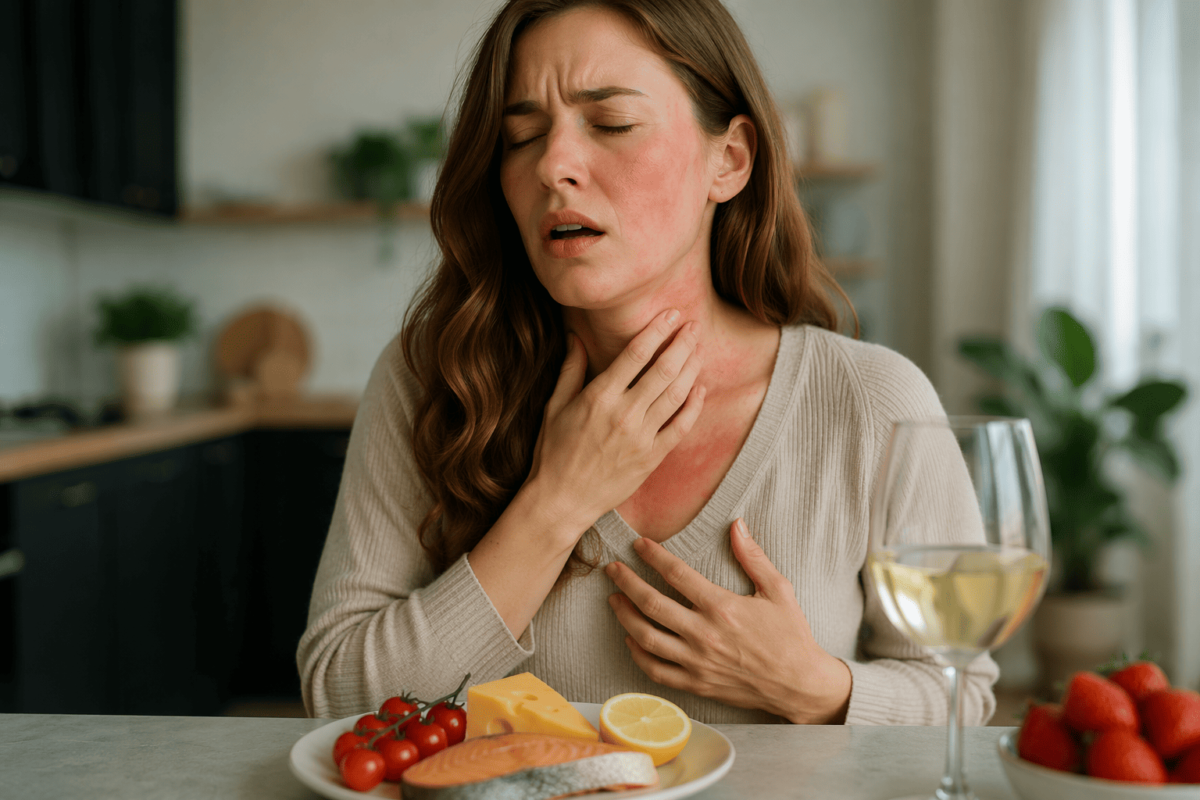
- skin reactions: redness, itching, feeling of heat;
- headaches or a feeling of heaviness in the head;
- bloating, abdominal discomfort, unstable digestion;
- runny nose or nasal congestion without signs of a cold;
- fatigue, weakness, or drowsiness after eating;
- a feeling of palpitations or internal tension after certain foods.
It is important to understand that such manifestations can accompany a variety of conditions. Therefore, this list of symptoms is not an instruction for self-diagnosis, but only a reason to be more attentive to your condition.
Why is there so much talk about it?
Histamine intolerance is really “on everyone’s lips” today. Why? There are several reasons.
First, interest in nutrition has grown. People began to observe the body’s reactions more closely and more often look for an explanation for their symptoms. Second, social networks actively amplify any topic where there is a clear scheme: product → reaction → ready-made diagnosis.
As a result, complex questions are often simplified to short conclusions. It may feel like almost any discomfort after eating can be explained in one word. But is it always so? Of course not.
Sometimes there are completely different reasons behind such complaints: digestive features, stress, chronic gastrointestinal diseases, deficiencies, malnutrition. And sometimes marketing noise forms around the topic: the more popular the new “diagnosis,” the easier it is to sell special diets, tests, and products.
Therefore, interest in the topic is understandable, but the approach to it should remain sensible.

What affects the level of histamine in the body
Several factors can affect histamine levels and the body’s reaction at the same time.
First of all, nutrition. More histamine is contained or can accumulate in fermented foods, aged cheeses, smoked meats, some canned foods, and alcohol. For some people, such products can cause more noticeable discomfort.
Stress also matters. It affects the general condition of the body and digestion and can increase sensitivity to familiar foods.
The work of the gastrointestinal tract is no less important. If the digestive system does not function well, this can affect the tolerance of certain foods.
In addition, the condition of the liver matters, since it participates in metabolic processes and the excretion of various substances from the body.
The role of the liver and intestines in histamine metabolism
The liver and intestines play an important role in breaking down and excreting excess histamine from the body. That is why the topic of intolerance is not limited to a list of “forbidden foods.”
The intestine is involved in digestion, absorption, and enzymatic processes. If its work is disrupted, this can affect how the body reacts to dietary load.
The liver, in turn, is involved in neutralization and metabolism of many compounds. When these systems are functionally overloaded, it can be more difficult for the body to maintain internal balance.
Can the issue be solved by diet alone? Not always. Sometimes it is important to look more broadly: at nutrition, lifestyle, the state of the gastrointestinal tract, and the overall load on the body.
Body support: not just diet
With an increased load on the body, attention is usually paid not only to diet, but also to supporting liver and gastrointestinal functions. In addition to diet, some plants are used for this purpose in traditional herbal medicine.
One of these plants is thistle pods. It is traditionally used for toxic liver damage, disorders of its functions, as well as to support the functioning of the liver and intestines.
Why is this important in the context of the topic under discussion? Because the ability of this plant to support the functioning of the liver and intestines is noteworthy: these systems play a key role in the breakdown and elimination of excess histamine from the body.
At the same time, it is important to maintain a realistic approach. Thistle pods is not presented as a remedy that “cures histamine intolerance” or is guaranteed to eliminate symptoms. We are talking about supporting the body within the framework of an integrated approach.


Before using any remedies, even herbal ones, it is necessary to consult a doctor, especially if symptoms recur or there are existing liver or intestinal diseases, or allergic reactions.
When should you see a doctor?
You should not postpone a consultation if:
- symptoms appear regularly;
- the condition worsens or reactions become more pronounced;
- discomfort occurs after various products and interferes with normal life;
- dietary restrictions do not give a clear result;
- new complaints related to the skin, gastrointestinal tract, or general well-being appear.
A doctor will help rule out other causes, assess the state of the digestive system, and choose tactics without guesswork and random restrictions.
Conclusion
The topic of histamine intolerance is more complicated than it seems from publications on the Internet. Not every symptom after a meal is associated with an excess of histamine, and not all cases can be explained by a fashionable term. Self-diagnosis here is more of a hindrance than a help. An integrated approach is much more important: attention to nutrition, the condition of the liver and intestines, and most importantly—consultation with a specialist.
Literature
- Comas-Basté O., Sánchez-Pérez S., Veciana-Nogués M. T., Latorre-Moratalla M. L., Vidal-Carou M. C. Histamine Intolerance: The Current State of the Art (https://pmc.ncbi.nlm.nih.gov/articles/PMC7463562/).
- Jochum C., Hohmann C., Wöhrl S. Histamine Intolerance: Symptoms, Diagnosis, and Beyond (https://pmc.ncbi.nlm.nih.gov/articles/PMC11054089/).
- Ministry of Health of Ukraine. Guideline 00299. Food allergy and hypersensitivity in children (https://guidelines.moz.gov.ua/documents/3182).
Author: Natalia Kandybey, Candidate of Pharmaceutical Sciences, Quality Director of PJSC Pharmaceutical Factory “VIOLA”
Subscribe to our pages on social networks: Facebook and Instagram


