
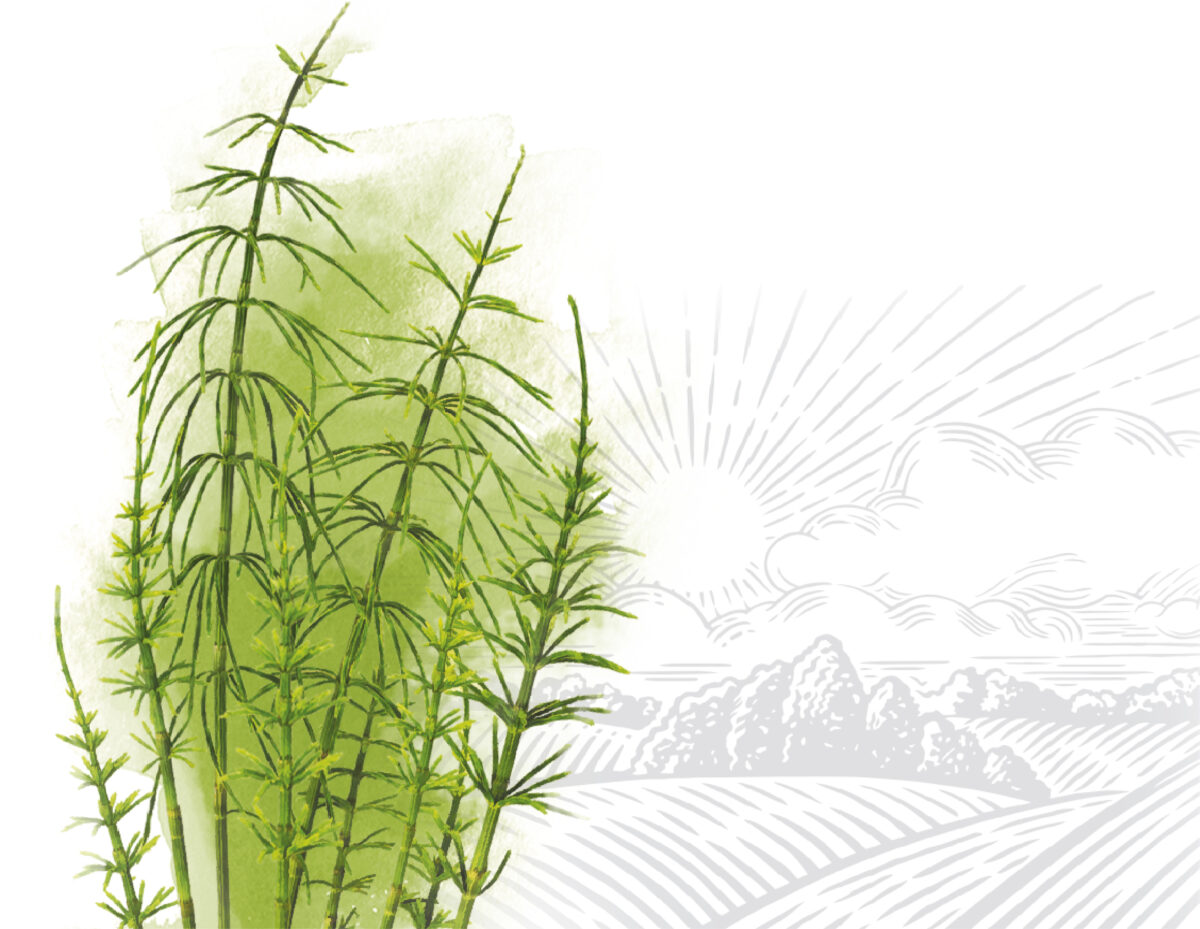
Horsetail (Latin: Equisetum arvense) is a medicinal plant traditionally used in herbal medicine as a diuretic and as a component of external care. It is valued for its combination of silicon compounds and plant biologically active substances. At the same time, horsetail is not a “universal herb”: it is important to consider contraindications, age restrictions, and the rules of course use.
What is horsetail
Horsetail is a perennial herbaceous plant from the horsetail genus. For medicinal purposes, the aerial part (the herb) is used; it is dried and prepared as plant raw material. The raw material usually has a grayish-green color, a faint smell, and a slightly sour taste—these signs are characteristic of well-dried herb.


Horsetail and other types of horsetail: what is the difference
There are many horsetail species in nature, and they may look similar. Equisetum arvense is the species chosen for use; in other species, the composition and safety may differ. Therefore, it is better to use raw materials with a clear origin and labeling, and not to collect the plant “by eye.”
Brief botanical description and where it grows
The plant forms jointed stems with nodes and tufts of lateral twigs. It grows in meadows, fields, forest edges, along roads, and near bodies of water, preferring moist soils. During the harvesting season, it is important to collect horsetail away from industrial areas and highways, as the raw material can accumulate pollutants.
Chemical composition of horsetail
Horsetail’s medicinal properties are largely related to its mineral content and plant polyphenols. The exact concentration of active substances depends on growing conditions and the method of preparing the raw material.
Main active ingredients
One of the most well-known features of horsetail is its content of silicon compounds. Silicon is important for the body as a structural component of connective tissue: it participates in forming the “framework” of the skin and also supports the condition of joints and ligaments.
Horsetail herb contains flavonoids, organic acids, and other biologically active compounds. They are associated with a mild anti-inflammatory effect and support of microcirculation, which is important for external use and as part of complex phytotherapy.
Why the composition determines the medicinal properties
The mineral part (including silicon compounds) is more often viewed as a basis for supporting connective tissue, while polyphenols are seen as contributing to anti-inflammatory and antimicrobial potential. Therefore, the benefits of field horsetail are usually discussed in the context of fluid excretion and overall tissue “tone.”
Medicinal properties of horsetail
Below are the main areas where horsetail is most often used. The wording is intentionally cautious: the plant is used as an adjunct and does not replace treatment prescribed by a doctor.
Diuretic and anti-edema effect
Horsetail belongs to diuretic herbs and may contribute to an increase in diuresis. It is used in conditions accompanied by edema, when increased fluid excretion is appropriate and safe.
Benefits for the kidneys and urinary tract
Horsetail is used for the kidneys and urinary tract as a supportive option for complaints related to urinary excretion (for example, cystitis, urethritis, pyelitis)—usually as part of an integrated approach. In inflammatory kidney disease, use may be contraindicated.
Benefits for joints, bones and ligaments
Horsetail for joints is often chosen for its silicon compounds and their role in supporting connective tissue (joints and ligaments). It is more realistic to view the effect as gradual support alongside nutrition and lifestyle, rather than a “quick fix.”
Benefits for skin, hair and nails
Horsetail for hair, skin, and nails is used both internally and externally. Internal use is considered a general supportive factor, and external use is considered a method of local care (baths, compresses). The condition of skin and hair depends on many factors, so horsetail is best seen as one element of care, not the only answer.
Anti-inflammatory and healing effects
The biologically active substances in the herb may contribute to anti-inflammatory and antimicrobial effects. In everyday use, horsetail is more often applied externally—for superficial skin injuries and for baths/lotions.
The use of horsetail in folk medicine
For what conditions is it used?
In folk medicine, horsetail is used for conditions accompanied by fluid retention, as well as for some urinary-tract complaints. The plant is also mentioned as an adjunct component for bleeding of various localizations (but only after a doctor determines the cause). Separately, its use as part of complex therapy for acute and chronic lead poisoning is noted: horsetail infusions may contribute to the removal of lead from the body.
As part of herbal preparations and complex phytotherapy
Horsetail is often combined with other herbs, such as plants with mild anti-inflammatory or antispasmodic potential. If you take medications at the same time (especially diuretics, blood-pressure drugs, or anticoagulants), it is better to coordinate such combinations with a specialist.
How to use horsetail: forms and methods
In practice, an infusion, “tea” (a more common name for an infusion), and external methods are used. Below are common preparation options.
Infusion and decoction
Infusion of chopped herb:
Place 2 tablespoons of the herb in an enamel bowl, pour 200 ml of hot boiled water, close the lid, and keep in a boiling water bath for 15 minutes. Cool at room temperature for 45 minutes, strain, and squeeze out the remaining liquid. Bring the volume with boiled water to 200 ml. Shake the infusion before use.
Infusion from filter bags:
Place 2 filter bags in a glass or enamel container, pour 200 ml of boiling water, cover, and leave for 15 minutes.
Horsetail tea
Horsetail “tea” usually means the same infusion: the raw material is poured with boiling water and infused. The main rule is not to increase the concentration “for effect” and not to increase the frequency of intake unnecessarily.
External use (compresses, baths)
For compresses and lotions, use a warm infusion, then cool it to a comfortable temperature. For baths, add the infusion to the water. External methods are especially appropriate when the goal is local skin care and support.
How to take: general recommendations
Course duration
Usually, the infusion is taken warm 3–4 times a day about 1 hour after meals. Single doses depend on age: adults and adolescents from 14 years old often use 1/4 cup, and at 12–14 years old smaller volumes. The course duration is selected individually.
Why you can’t take it continuously
Long-term use without breaks is undesirable. Adverse reactions from the kidneys (tissue irritation) are possible, and the risk of dosing errors also increases over time. Therefore, horsetail is more often considered a remedy for course use.
Contraindications and possible harm
Who is horsetail contraindicated for?
- People with nephritis/nephrosis/nephrosonephritis: may irritate kidney tissue and worsen symptoms.
- Pregnant women: do not use, as it is considered unsafe during this period.
- Women who are breastfeeding: do not use—there is not enough safety data for the baby.
- People with horsetail allergy or a tendency to allergic reactions to herbs: may cause itching, rashes, or redness.
- Children under 12 years old: do not use orally—there is no established safe regimen for this age.
Important: if lower back pain or pain at the end of urination appears while taking horsetail, stop use and consult a doctor—this is a typical signal that the kidneys may not tolerate it.
Possible side effects and limitations
Allergic reactions (redness, itching, rashes) are possible. Sometimes horsetail can cause irritation of kidney tissue, which may present as lower back pain or discomfort at the end of urination. If any undesirable symptoms appear, stop taking it and consult a doctor.
Frequently Asked Questions
Can I drink horsetail daily?
Daily intake on a regular basis is not recommended. Usually, horsetail is used in courses with breaks to reduce the risk of kidney irritation and dosing errors. If you need a long course, it is better to discuss it with a doctor.
Is horsetail suitable for children?
For internal use, guidance is usually based on the age of 12 years. Dosages depend on age and the form of the raw material. Children under 12 years of age should not use it orally without a doctor’s supervision.
Can I take it during pregnancy?
No. During pregnancy and breastfeeding, horsetail should not be used.
What are the benefits of horsetail for joints?
Horsetail for joints is chosen primarily because of silicon compounds and their role in supporting connective tissue. This is not a “quick analgesic effect,” but potential support alongside nutrition, movement, and overall treatment.
Can horsetail be combined with other herbs?
In herbal medicine, combinations are common, but individual tolerance and compatibility with drugs may differ. If you take regular medications or have chronic diseases, it is better to coordinate herbal preparations with a specialist.
Conclusions and recommendations
Horsetail is a medicinal plant traditionally used as a diuretic and anti-edema agent, as well as for external care. Its use is associated with supporting fluid excretion, moderate anti-inflammatory potential, and interest in the role of silicon in connective tissue (joints and ligaments, skin and hair health). At the same time, contraindications for field horsetail must be considered: in kidney disease, pregnancy/breastfeeding, and allergies, it should not be used. The best approach is course use, adherence to dosages, and consultation with a doctor for chronic diseases or when taking medications.
References
- European Medicines Agency (EMA). Assessment report: Equisetum arvense L., herba. (https://www.ema.europa.eu/en/documents/herbal-report/final-assessment-report-equisetum-arvense-l-herba_en.pdf)
- Analysis of lipophilic extract of horsetail herb (Equisetum arvense L.) by gas chromatography with mass detection (https://www.researchgate.net/publication/390716223_Analiz_lipofilnogo_ekstraktu_travi_hvosa_polovogo_Equisetum_arvense_L_metodom_gazovoi_hromatografii_z_mas-detekcieu)
- ESCOP. Monograph summary: Equisetum (horsetail) — constituents incl. silica, flavonoids, thiaminase. (https://www.escop.com/downloads/equiseti-herba-equisetum-stem/)
Author: Natalia Kandybey, Candidate of Pharmaceutical Sciences, Quality Director of PJSC Pharmaceutical Factory “VIOLA”
Subscribe to our pages on social networks: Facebook and Instagram


